Wednesday, April 2, 2025

The Complete Little Stories for Bedtime, Year 5. 1916


Harrison Cady illustration of Peter Rabbit and Poor Mrs. Quack.

Newly uploaded, The Complete Little Stories for Bedtime by Thornton W. Burgess 1916. All the stories from that year plus four appendices, including Burgess's personal letters to Bedtime Stories Clubs, documentation about the 1916 productions of "Peter Rabbit in Dreamland," newspaper commentary about Burgess and his competitors, and documentation of Quaddy and other Burgess-related merchandise.

Tuesday, July 23, 2024

The Complete Little Stories for Bedtime, Year 4. 1915.

Image from Story 1072, "Bumpy Flies Without Wings."

I've just uploaded the fourth, and last (for the foreseeable future) installment of The Complete Little Stories for Bedtime by Thornton W. Burgess. It covers 1915, which was a big year for Burgess. He wrote story 1000, introduced his "Quaddy" brand, and met thousands of his fans in person at a "monster meeting" at Bronx Park sponsored by the Bedtime Stories Club of the New York Globe. The pantomime extravaganza, "Peter Rabbit in Dreamland," had its debut at the end of the year, also sponsored by The Globe. And Burgess wrote his first real piece of anti-recreational hunting propaganda, a series of stories featuring the Bob White family, setting up his future relationship with conservationist William T. Hornaday. 

This one took a little more work than the other volumes, including many hours at the New York Public Library browsing microfilm, but it has inspired an audio project on the otherwise little documented "Peter Rabbit in Dreamland," coming soon.

Friday, March 8, 2024

The Complete Little Stories for Bedtime by Thornton W. Burgess. Year 3. 1914.

Illustration by Harrison Cady of Story 664. "Old Mr. Toad's Mistake."

 I've just uploaded the third volume of the Complete Little Stories for Bedtime by Thornton W. Burgess. This one compiles his newspaper stories, #591 to #902, from 1914. This was the year of the first Bedtime Stories Clubs (exhaustively documented) and the year that Farmer Brown's boy became the friend of the folks of the Green Meadows and Green Forest. Here is an opportunity to read these stories in their original continuity. Note that there are plans for a fourth volume but my work will shift to audio for the near future. 

I've been recording myself reading some of Burgess's stories, beginning with the first published story featuring his Green Meadows/Forest characters, "How Reddy Fox was Surprised," which appeared in Good Housekeeping, April 1910, and is most famous as either chapter 3 or 4 of Old Mother West Wind, depending on the edition. As an experiment, I mixed together a mash-up of my own reading together with nine other recorded readings of the story, with some interesting results. I was surprised, for example, at the number of moments when line readings, recorded completely independently, synced almost perfectly together. I've uploaded the mash-up for anyone who is interested, though the overall effect is of an comically under-rehearsed group reading performance. 

Wednesday, February 14, 2024

The Complete Little Stories for Bedtime 1913 Edition


Thornton W. Burgess writing a bedtime story. (Publicity illustration)

As promised last post, I've compiled a second volume of Little Stories for Bedtime, this time covering a full year (1913), and have included an introduction and index, along with three appendices. The first appendix compiles publicity copy, reader comments, and other references to Burgess's stories in newspapers; the second appendix looks at names and natural history in the stories, this time focused on Peter Rabbit; the third details the publication of one of Burgess's favorite non-Little Stories for Bedtime stories, "The Joy of the Beautiful Pine." As always please alert me to any mistakes you might be discover so I can upload a revised edition, but I tried to be careful this time around. 


Wednesday, January 17, 2024

The Complete Little Stories for Bedtime by Thornton W. Burgess. Year 1. 1912.


In honor of Thornton W. Burgess's 150th birthday, I've uploaded a collection of his newspaper stories from February 5 to December 31, 1912, the first year of the "Little Stories for Bedtime" feature. I've also included illustrations, when available (they are of mixed quality) and some annotations, particularly with respect to places these stories were republished.

Many of these stories will be familiar to readers of his books but many will be brand new. Publishing them in their original order also means restoring the original continuity, which would effectively last until story 15,000 in 1960. The numbering and dating of these stories are best guesses. It is possible that there are missing stories, and I've included one such candidate (unnumbered) in the collection. 

At any rate, I will continue this publication project, aiming for one release a month, during the TWB 150th celebration. 

[UPDATE: I've uploaded an expanded and corrected edition of the 1912 book that includes three new appendices, a revised introduction, and an index. And spell-checked.]

Monday, January 1, 2024

The Collected Writings of Thornton W. Burgess, 1895-1911

In anticipation of the 150th anniversary of Thornton W. Burgess's birth coming later this January, I've put together this volume which assembles all the writing he did (that I could find) from the beginning of his career right up until he became a household name in 1912. Nearly 700 pages, uploaded to archive.org as a pdf. Here's the link: The Collected Writings of Thornton W. Burgess, 1895-1911. Consider this the first edition.

Dowhan's bibliography was my main finding guide but I was able to find a number of texts that he didn't list, both by stumbling upon them during digital searches and via a scrapbook in the TWB archives in the Massachusetts Historical Society. I've also included uncredited work in the American Agriculturist that is very likely to be the work of Burgess while he was "Young Folks' Editor" for that publication. 

Note that a handful of items included reveal an uncritical reproduction of ethnic and racial stereotypes. And Burgess's celebration of hunting and trapping (always within the framework of "true sportsmanship") may be shocking to readers who see him as an eternal "friend of the animals." See the Bob White poem from the Springfield Homestead below.

Image of Bob White poem

At any rate, I've brought back the blog. Big plans ahead as part of a larger TWB celebration in 2024!


Sunday, September 8, 2013

New Burgess Biography: Nature's Ambassador by Christie Lowrance


I am pleased to announce the publication of Christie Lowrance's new biography of Thornton W. Burgess. It is the first truly comprehensive Burgess biography. (Even TWB's own Now I Remember is more a series of memoirs than a true life story).

A careful reader of this blog and other existing accounts of his life will already have the broad outline of TWB's work and its significance. (Indeed, this blog is acknowledged (and recommended) as a useful resource [Thanks, Christie!]). Lowrance's special contribution (beyond putting everything in a cohesive package) is more access to Burgess the man (she draws extensively from his journals and correspondence) and more evidence about his legacy (she interviewed dozens of people [including me], some of whom knew TWB personally). I think she makes a compelling case that Thornton W. Burgess deserves more credit than he currently receives for influencing our relationship with the natural world.

At any rate, it is highly recommended and available through the Burgess Society website.

Tuesday, January 1, 2013

New Page: Burgess Bedtime Story posts

To make it easier for future readers to make it through the 50-plus Burgess Bedtime Story posts, I have constructed an index page. Readers, of course, can already navigate from year to year simply by following the "older post" and "newer post" links at the bottom of each post. Nevertheless, I thought it might be useful for readers looking for a particular year to have a full linked list. The page does not include posts that are about things other than the stories themselves.

Saturday, December 29, 2012

Online sources for Burgess newspaper stories

I've provided some of this information in a previous post but I thought it might be useful for some readers who might be inspired to track down some of the actual stories I've written about.

Google News Archives is the best free source, and so that's what I'll focus on.

The dates in parentheses indicate the years of the paper in the Google collection overall. The second pair of dates is the approximate starting and stopping point for Burgess stories. You will have to search the issues individually to find the stories, though by the 1930s they were usually run on the comics page.

Note that the Google collections are sometimes spotty with entire quarters occasionally missing. It usually works to move between the Lewiston Daily Sun and the Saskatoon Star-Phoenix. When both collections have holes at the same time, I usually had to move to a pay site to get the missing issues.


Milwaukee Journal (1884-1995) February 9, 1915-April 28, 1926

The Lewiston Daily Sun (1890-1989) April 4, 1921- November 10, 1943/ Dec 11. 43-October 21, 1961

The Deseret News (1832-2003) 1918/June 21, 1921-July 31, 1933

Youngstown Vindicator (1807-1984) July 6, 1921-January 16, 1932.

The Border Cities [Windsor, ON] Star (1918-1952) May 11, 1922 to June 4, 1925

Quebec Daily Telegraph (1812-1925) April 10, 1922-October 15, 1924

Pittsburgh Press (1819-1992) August 22, 1927-April 25, 1931.

Saskatoon Star-Phoenix (1851-1967) January 2, 1929-1965

Warsaw Times-Union (1949-1977) March 16, 1953-December 29, 1955. 

Edmonton Journal (1913-1986) May 1, 1953-May 31, 1955

Eugene Register-Guard (1867-2008) September 5, 1955-May 4, 1961.

Thursday, December 27, 2012

Modular Story-telling

One of the things that first surprised me when I started investigating Thornton Burgess's newspaper stories was how modular they were, each a little unit that could stand alone or be combined with other units in a variety of ways. The first Bedtime Stories books, far from being reprints of continuous narratives from the newspaper serial, were very often composites of stories originally told months, sometimes years apart. These modular stories were only lightly edited for use in the books, if at all.

This modularity reached a whole new level when it came to the Burgess books published in the 1940s. Take, for example, At the Smiling Pool, which pieced together stories originally published from 1926 to 1943, sometimes, as in the case of "Peeper's Adventures", piecing together stories from many years apart to make a single chapter, or, as in the case of "Grandfather Frog's World," switching a story out of its original order in the continuity.

Below is the complete list of At the Smiling Pool chapters and the date of their original newspaper publication.

1. The Voice of Spring [March 30, April 1, 1942]
2. Peter Stops a Chorus [April 2-3, 1937]
3. Peeper's Adventures [April 9, 1926; May 7, 1934]
4. The Happy Trio [May 8-9, 1934]
5. The Smiling Pool Philosopher [June 7-8, 1934]
6. Grandfather Frog's World [September 11, 1940; August 15, 1935]
7. Taddy the Tadpole [May 24-25, 1937]
8. Taddy Meets his Father [May 26-28, 1937]
9. The Reward of Patience [September 7 and 9, 1940]
10. Little Mr. Know-it-all [September 12-14, 1940]
11. Jerry Muskrat is Envious [August 13-14, 1935]
12. Prickly Porky Seeks a Change [August 18-19, 1942]
13. An Honorable Retreat [June 21-23, 1939]
14. An Anxious Morning [May 31 to June 1, 1934]
15. Lessons in Living [June 2-4, 1934]
16. Greedy Touslehead [June 5-6, 1934]
17. Blacky's Chagrin [August 23-24, 1940]
18. Blacky Finds a Way [August 26-27, 1940]
19. Friendly Neighbors [May 7-8, 1940]
20. Mrs. Little Friend is Upset [May 10-11, 1937]
21. Surprising Babies [May 12-13, 1937]
22. Mrs. Slippery Slim [November 15-16, 1939]
23. A Happy Farewell [November 17-18, 1939]
24. Peter Makes a New Acquaintance [May 16-17, 1929]
25. A Secret is Kept [May 22-24, 1929]
26 The Happy Family [May 25 and 27, 1929]
27. The Water Sprites [May 28 and 29, 1929]
28. A Matter of Opinion [September 16 and 17, 1943]


Tuesday, December 25, 2012

Burgess Bedtime Stories 1960


The Stories


January 1 to January 8. Old Man Coyote tries to get beavers and grouse but fails. Little Joe Otter leaves fish for him to eat.

January 9. Tommy Tit isn't afraid of Jack Frost.

January 11 to January 16. Peter Rabbit finds himself too far from the Old Briar Patch and is almost caught by Whitey the Snowy Owl. Luckily Terror the Goshawk gets in the way and Peter makes it safely to a bramble-tangle. Peter decides he is getting old and will follow Jumper the Hare's advice to stay in the Old Briar Patch from now on.

Notes

The end of 48 years of Burgess Bedtime Stories was relatively abrupt with closure coming in a mere two stories. On January 15, Peter Rabbit, breathing hard from a race with Whitey the Snowy Owl that Peter almost lost, began to worry.
"I guess I'm getting old," thought Peter. "That Owl nearly caught me. I didn't dodge him as well as I used to. If this bramble-tangle had been any farther away I guess I would never had made it. I don't think I'll come over here [Green Forest] anymore..." 
"Somehow I don't feel just the way I used to. I can't run as fast as I once could. I think I can, but when I try to I find I can't. If I should meet Reddy Fox out on the Green Meadows I'm afraid I couldn't get back to the dear Old Briar Patch as I have so many times before. My legs are not what they used to be. No, sir, my legs are not what they used to be. When a fellow's legs play out it's time to stay at home. It isn't that I want to stay at home, because I don't. I like to get about and see what is going on. That is what legs are for." For a long time Peter continued to worry. 
[In his 1960 Life profile Burgess's only complaint about aging was the state of his legs.] January 16, Jumper the Hare came along and helped Peter make a final decision.
"If your legs really are not what they used to be, and you can't dodge as you used to dodge, there is only one thing for you to do," said Jumper. 
"I suppose, you mean, stay in the Old Briar Patch," said Peter. 
"That's just what I mean," replied Jumper. "Hasn't Mrs. Peter told you that?" 
"More times than I can remember," replied Peter. "She hardly ever leaves it."
Moreover there was an ethical reason why Peter should stay put:
"...If as you say, you are getting old, it is time to stop taking chances. You had better get back to the dear Old Briar-patch and stay there. You will save yourself a lot of trouble and danger, and perhaps save some other people, too. If it hadn't been for your being over here, Whitey the Snowy Owl and Terror the Goshawk would not have had a fight. And Terror wouldn't have lost two tail feathers." 
"I don't care if he did. I'm glad of it," said Peter. "Those two don't belong down here anyway." 
"But they are here. You don't want to forget that, Peter. They are here, but not over in the dear Old Briar-Patch," declared Jumper. 
And that was the end. It appears that there was supposed to be at least one more story. Previewed for the following Monday was "Peter's Last Race." And indeed, in the story above Peter had not yet returned to the Old Briar Patch, he was still in the bramble-tangle. He would need to make one more race in order to get there. But as far as I can tell that story was never published. One would assume Burgess intended for Peter to arrive safely but one wonders, given Burgess's trend toward naturalism, whether Peter might have illustrated the principle that animals in the wild rarely die of old age...

On Monday January 18, instead of "Peter's Last Race," there was a story from January 7, 1935, titled "A family gathering." It was run under the heading, "Nature Stories" (Burgess's preferred title for his series since the mid 1930s) and ran without an accompanying Harrison Cady illustration. For the rest of 1960, newspapers carrying Burgess stories continued the 1935 repeats. The series continued in repeats, primarily from the 1930s, until 1965. Burgess himself would die in June of that year. 

Monday, December 24, 2012

Presenting A New Burgess Bedtime Stories Book


The Adventures of Rusty the Fox Squirrel
This book compiles "Burgess Bedtime Stories" from November 1, 1920 to December 16, 1920. I consider it one of Thornton W. Burgess's "lost books." While I have no evidence that he intended to publish it as a separate book, Burgess wrote it as a continuous narrative and although it contains familiar elements (Farmer Brown's boy takes care of a wounded animal, squirrels compete over nuts) I think it stands together as something new. Burgess's storytelling is top-notch throughout.

To parents who might want to read this to their children a few notes are in order. First, as in other Burgess books from this era (The Adventures of Poor Mrs. Quack and The Adventures of Bob White come to mind) there is a scene of violence involving a hunter and a gun. Second, Farmer Brown's boy's behavior in reaction to the hunter, while showing his deep commitment to the rights of his animal friends, is probably not something some parents would want their children to imitate. Finally, Burgess tells the story slowly, with a lot of recapitulation (these stories were serialized in newspapers), and the occasional archaic sentence construction. This is something I now appreciate, but the attention of smaller children will sometimes wander.

I've tried to keep my editing to a minimum. The design is based on the earliest Burgess Bedtime Story books, which were, limited by the printing technology of the day, probably not laid out for optimum readability. At some point in the future I will likely explore other book designs, as well as ebooks. The original is in an InDesign file, so I am also pursuing the possibility of actual printing (to be distributed via an "abandoned art" model I've used before).

Please enjoy and distribute freely. While I've embedded the book above, I think the reading experience is better via the downloaded pdf. [UPDATE: now, regrettably, behind a Scribd paywall.]


Sunday, December 23, 2012

Burgess Bedtime Stories 1959


The Stories


January 1 to January 16. Buster Bear breaks into the sugar house before settling down to sleep under a snow blanket. Meanwhile Reddy and Gray Fox jump when they catch the scent of Mother Bear and her new babies.

January 17 to January 24. Little Woody the Wood Mouse foolishly thinks he's safe because Buster Bear is sleeping close by his house.

January 26 to February 16. Rusty the Fox Squirrel moves because he fears (justifiably) that his tree won't last the winter. Yowler the Bobcat plans to catch him in his new nest until Tufty the Lynx interferes. After Tufty steals his hen, Yowler puts a dog on his trail, driving the Lynx from the Green Forest for good.

February 17 to February 23. Mrs. Grouse eats Chatterer the Red Squirrel's nuts.

February 24 to February 26. Danny Meadow Mouse wishes there was snow on the ground all year long. 

February 27 to March 6. It's Spooky the Screech Owl's turn to be trapped in a hole after an ice storm. Farmer Brown's boy comes to the rescue. 

March 7 to March 23. Crows mob Chatterer the Red Squirrel when he tries to get crow eggs but their mobbing action turns tragic when they try it on Mrs Hooty.

March 24 to April 3. King Eagle watches Reddy Fox do his silly duck catching dance. Then steals his duck. Later Reddy gets even by stealing a fish dropped by an osprey in tribute to eagle.

April 4 to April 18. Sharpshin the Hawk can't figure out where the bluebirds are nesting (a hole in a fence post). 

April 20 to May 1. Mrs. Woodcock attacks Peter Rabbit for giving away the location of her nest. 

May 2 to May 21. Peter Rabbit asks Johnny Chuck a lot of questions about hole digging, then is surprised to learn that woodchucks eat cherries, and even grasshoppers on occasion.

May 22 to June 23. Little Jerry Junior learns to fear Snapper the Turtle after he sees him kill a duckling and then his little sister. Later Mrs. Snapper leaves the Smiling Pool to lay eggs. Jimmy Skunk gets there before Bobby Coon. 

June 24 to July 21. Mrs. Possum hisses at Peter Rabbit when he tries to follow her. He admires her tail. Then Peter asks Unc' Billy to teach him how to play dead. Peter gets a scary demonstration when a dog shakes a "dead" Unc' Billy. Peter is not very skillful at playing dead himself.

July 22 to August 1. Big Bully the Dog needs two bouts with Prickly Porky to learn to avoid him. Later, "not wholly stupid," he infers that skunks are not to be messed with when Prickly steps aside for Jimmy Skunk and decides that a buzzing rattle means a rattlesnake is dangerous.  

August 3 to September 16. Reddy Fox, who must provide for his new family, leads a dog away but finds his path blocked by a rattlesnake. Later six little foxes go to school on the Old Pasture. Little Red shows hunting talent. Then his father teaches him tricks to avoid dogs. Finally he is ready for independence. 

September 17 to September 29. Young Bob White, wounded by a hunter, stays in the Old Briar Patch. Then a stalking Black Pussy is frightened by an explosion of bobwhites.

September 30 to October 7. Johnny Chuck, chased by a dog and too fat to run, choose to fight. Jimmy Skunk helps out, in exchange for using old woodchuck holes in the winter. 

October 8 to October 21. Farmer Brown's boy rescues Sooty the Chimney Swift after he wets his wings in the river water. 

October 22 to November 2. Nimbleheels the Jumping Mouse is ready to go to sleep but gets one last jump in over the head of Black Pussy.

November 3 to November 18. Instead of moving Striped Chipmunk decides to simply rearrange his house when Shadow the Weasel shows up. Then he gossips with Polly Chuck about winter preparations.

November 19 to December 12. Peter Rabbit visits Lightfoot the Deer and watches him fight a rival. The rival bucks get their antlers locked but the sudden appearance of Buster Bear and a lucky twist frees them. Later Buster wanders all the way around Great Mountain. 

December 14 to December 28. Young Bob becomes "Crippy" after he loses his leg in a trap. On Christmas a young trapper finds the leg, vows never to set another trap, and leaves food for the raccoon.

December 29 to December 31. A big snow storm makes hunting hard for foxes. (continued in 1960).

Notes


1959 was the last full year of new Burgess stories, though there was little sign that the series was coming to an end. Rather stories continued as they had in the past few years, a lot of repetition and a few new ideas. There was a return to explicitly humorous moments (more common in the earliest years than lately) with Peter Rabbit foolishly trying to play dead like Unc' Billy Possum (akin to his failed attempts to hibernate and be thrifty) and Buster Bear going wandering and finding that he had just made a giant circle. It is also worth noting a rather gruesome Christmas story, Burgess's last, centered around the discovery of a disembodied raccoon leg in a trap, though the present for the Green Forest would be the end of the young trapper's trapping career.

In 1959 Peter Rabbit's incessant curiosity (fueled, as Burgess himself indicated, by a staggering level of forgetfulness) was met with hostility at least twice. This had been a trend in Burgess stories, as Peter tried to discover things (particularly nesting locations) that were supposed to be secret. In 1959 Mrs. Woodcock actually attacked him (Mrs. Possum merely hissed at him). And in fact Mrs. Woodcock had been justified because Peter effectively led potential predators straight to her hiding place. It is worth reflecting on the pros and cons of his curiosity. On the one hand, Peter's constant need to know modeled an eager student and allowed Burgess to teach nature facts.  On the other hand, to the extent that some degree of secrecy is necessary in the animal kingdom, it might be possible to know too much--or more than is in the best interest of the animal. 

Friday, December 21, 2012

Burgess Bedtime Stories 1958


The Stories


January 1 to January 16. (continued from 1957) Pekan the Fisher chases Spite the Marten through the treetops. Then Glutton the Wolverine destroys a trapper's cabin. And chases away a Puma.

January 17 to January 27. Peter Rabbit accuses Jimmy Skunk of killing Johnny Chuck.

January 28 to February 3. Bobby Coon wakes up from his long sleep just in time to meet Polly Chuck, who has no idea how long the winter will last. They both go back to sleep. (She saw her shadow.)

February 4 to February 14. Peter Rabbit reflects on the nature of predator-prey relationships after he sees an owl kill a mouse. Then he finds the Smiling Pool to be a lonesome place until Starnose the Mole and Mourning Cloak appear.

February 15 to March 5. The foxes use Prickly Porky to stop a pursuing dog.

March 6 to March 8. Peter Rabbit discovers a sign of spring--buds are sweet.

March 10 to March 25. Johnny Chuck has fun with Reddy Fox but Flip the Terrier chases him up a tree. And Redtail the Hawk (who sees owls nesting in his old nest) is in the area. 

March 26 to March 31. Welcome Robin and Old Mr. Toad are glad to be able to find earthworms again.

April 1 to May 15. Bob White envies Ol' Mistah Buzzard's soaring ability. Then Bob and Mrs. Bob must try to protect their eggs and chicks from predators. Meanwhile Mrs. Bob and Mrs. Grouse argue about the best place to raise children.

May 16 to June 7. The other chipmunks display prejudice against Little Black Chippy. He commiserates with Blacky the Crow and learns to defend himself. 

June 9 to June 14. Old Mr. Toad is dismayed at Grandfather Frog's cannibalism and gluttony (he successfully catches and eats a careless young sparrow), particularly when it causes other animals (e.g., a child of Teeter the Spotted Sandpiper) to misjudge toads.

June 16 to July 14. Peter Rabbit insists on visiting Farmer Brown's garden, despite the warnings of Mrs. Peter and finds himself trapped in a roll of wire netting and pursued by Reddy Fox and Redtail the Hawk. Farmer Brown's boy eventually sets him free.

July 15 to August 9. Nimbleheels the Jumping Mouse squabbles with Danny Meadow Mouse, wins a jumping contest against Peter Rabbit, and springs right over the head of Reddy Fox. Then Nimbleheels the (meadow) Jumping Mouse meets Little Jumper the (woodland) Jumping Mouse and later Little Jumper meets Jumper the Hare. 

August 11 to August 25. Lots of small folk assemble at the "meeting place" (an old stump) but are scared off when Sammy Jay does his hawk imitation. Then Lightfoot the Deer disagrees with Prickly Porky about the benefit of fear (especially when there is nothing apparent to be afraid of). The smaller animals scorn Lightfoot, a big person, for his fear until he brings up human hunters and dogs.  

August 26 to September 29. Mrs. Timmy the Flying Squirrel moves her babies in the nick of time (blacksnake).  Later her son, Junior, must learn to glide without hurting himself and distrust foxes, raccoons, and weasels. His heedless young brother is killed by Buster Bear. 

September 30 to October 25. Old Mr. Toad must make the dangerous journey back to the garden from the Smiling Pool. Farmer Brown's boy gives him a lift (he is not happy being carried) and Peter Rabbit offends him by comparing him to Grandfather Frog. Meanwhile Peter learns more toad-related facts.

October 27 to October 31. Johnny Chuck is very content and big enough to ward off a fox.

November 1 to November 14. Grouchy the young raccoon must learn the hard way to respect skunks.

November 15 to December 1. Striped Chipmunk must move after Mr Blacksnake discovers his home. Peter Rabbit learns about Chipmunk cheeks. And Lightfoot the Deer attacks Mr. Blacksnake and saves the day.

December 2 to December 14. Who stole Chatterer the Red Squirrel's giant mushroom? (Timmy the Flying Squirrel). 

December 15 to December 31. Blacky and Mrs. Blacky the Crow disagree on how to spend the winter. Blacky remains in the safety of the Green Forest sanctuary while Mrs. Blacky travels with a flock of crows and comes to regret her decision. 

Notes

Generally speaking, a look at Burgess's 1958 stories reveals a considerable amount of repetition from previous years, from Glutton's destruction of a trapper's cabin and Nimbleheel's jump over Reddy Fox's head, to Johnny Chuck's display of tree-climbing skill and yet another young animal who must learn to respect a skunk. While Farmer Brown's boy still appeared on the scene to feed animals and to rescue Peter Rabbit and Old Mr. Toad, his role overall remained diminished, and Burgess even had Old Mr. Toad resent the boy's assistance. Burgess's anti-hunting theme, while present, was restricted to very few actual stories (the shooting of crows at the end of the year). There was continued slippage between the season and the story (Mr. Toad surely would not be returning from the Smiling Pool in October) and Burgess even resurrected, from his very earliest stories, the device of a communal meeting between all types of animals, predators and prey, in order to talk about the place of "fear" in the animal world. 

One story line stands out as offering something new--a tale about "Little Black Chippy," a melanistic chipmunk who found himself the object of scorn simply because of the color of his fur.  Burgess had told many stories about the outcast status of albino and melanistic "freaks" previously but "Little Black Chippy" was a pretty clear allegory about racial prejudice. On May 22, Burgess used an aphorism to state the theme explicitly. 
Prejudice is mostly blind;
Being so, is most unkind.
--Old Mother Nature
What Old Mother Nature says is nearly always true. Prejudice is almost always unjust. It usually is the result of making up one's mind without knowing all the facts and seeing only one side of a thing when there may be many sides. Too often prejudice is made up largely of suspicion, and the two, combined, result in injustice.
Little Black Chippy was not only rejected by his fellow chipmunks but by the whole community, even kind-hearted Peter Rabbit.

Even Peter Rabbit wasn't too friendly. It seemed to Peter that if the little Chipmunk's coat was the wrong color there must be something wrong with him himself. So he would have nothing to do with little Black Chippy, although he was one of Striped Chipmunk's best friends. It appeared as if all the neighbors thought that a black one must be a bad one. 
So it was that little Black Chippy tried to keep out of sight as much as he could. As sure as he put his head out from between the stones of the old wall some was sure to scream, "Blacky! Blacky! Blacky!" Then he would dodge back. He was a most unhappy little Chipmunk, made so for no real reason at all. It is too often that way with prejudice.
He eventually met Black the Crow, who knew what it meant to be judged solely on basis of color. 
"I'm looking for a home. No one wants me around where I came from," replied the little Chipmunk. "They don't like me because my coat is black." 
Blacky's sharp eyes twinkled. "They wouldn't. They don't like me because I am black," said he.
"What is the matter with black? Why don't they like black? What difference does color make?" asked the little Chipmunk 
"It doesn't make any difference. Anyway, it shouldn't. We are just the same inside our black coats as if they were not black at all," said Blacky.

Burgess has sometimes been under suspicion for harboring racist attitudes and in his very earliest stories there may be some truth to this, particularly the minstrel show-style songs and humor of Unc' Billy Possum. In fact, Unc' Billy had not been featured in a story since 1950 [he would return briefly in 1959], and in the story of Black Chippy Burgess made it clear where he stood in 1958:
There is nothing in the world so unkind, so silly, so completely wrong as to judge someone else for their color. 

Wednesday, December 19, 2012

Burgess Bedtime Stories 1957


The Stories


January 1 to January 12. Farmer Brown's boy leaves a hen out for Reddy Fox to celebrate the New Year. Then Reddy pursues Starnose the Mole and is astonished to find out he can swim under water. Later Reddy watches muskrats and mink feed and fight under the ice.

January 14 to January 31. Blacky the Crow watches with envy as Ringneck the Pheasant feeds on Farmer Brown's boy's seed. Farmer Brown's boy leaves an ear of corn out for Blacky but Chatterer the Red Squirrel steals it. Blacky wins when Farmer Brown's boy squirrel-proofs the corn, Black Pussy chases Chatterer, and Chatterer's storehouse bursts. 

February 1 to February 2. Peter is startled to find Johnny Chuck awake. But Johnny has no idea whether the cold weather will continue or not. 

February 4 to February 9. Reddy Fox eats frozen apples then stalks Black Pussy and steals his meadow mouse. 

February 11 to February 20. Young Bucky is proud of his antlers but ashamed when they fall off. He feels better when he learns Lightfoot loses his as well. 

February 21 to March 30. Who has the earliest babies in the Green Forest? Bears, not great-horned owls. The bear cubs, Chubby, Tubbie, and Cubby, are told to stay away from the tree where Little Hoot and Little Toot are being raised but do they listen? Later Young Hoot learns the hard way that porcupines and huge snakes are to be avoided. 

April 1 to April 17. The Red-tailed Hawks make a new nest (the owls took their old one). Then Harrier the Marsh Hawk threatens the rabbit babies.

April 18 to May 4. Welcome Robin and Old Mr. Toad compete for worms driven to the surface by Miner to Mole.

May 6 to May 31. There is excitement in the Old Orchard as tree swallows and bluebirds put aside their quarrel and join together to force out the house sparrows. Then the barn swallows appear and Farmer Brown's boy puts out white feathers for the tree swallows. Mrs. Cresty wants snakeskin for her nest while Mrs. Chippy wants hair. Scrapper the Kingbird arrives and drives away Blacky the Crow.

June 1 to June 28. There is a scandal in the Old Orchard as Sally Sly, unsuccessful in placing an egg with the yellow warblers or wood pewees (Sammy Jay eats it), lays her egg in Mrs. Redeye the Vireo's nest. Later when Black Pussy scares the fledgling cowbird away, Sally Sly leads him to the cow pasture.

July 1 to July 17. The Goldies (Baltimore Orioles) drink the hummingbird sugar water and eat donuts and incorporate colorful yarn into their nest. Meanwhile Chatterer tries to get their eggs but is mobbed and knocked off the tree. He lands on Black Pussy and takes a ride on his back. 

July 18 to July 31. Sunshine the Yellow Warbler and Zee Zee the Redstart tell Tommy Tit about the birds of Trinidad.

August 1 to August 25. Mrs. Grouse is able to protect her eggs from Reddy Fox but is less lucky with her ten little chicks. Chickie, one of the remaining seven, gets his leg caught but is rescued when his mother fetches Farmer Brown's boy.

August 26 to September 4. Old Mr. Toad and Little Mr. Green Snake both change their suits but only Mr. Toad eats his. Then Old Mr. Toad and Peter Rabbit hang out and Peter admires the toad's tongue.

September 5 to September 21. Timmy the Flying Squirrel and Flitter the Bat agree that Timmy glides and doesn't really fly. Then Timmy finds himself stranded on the beaver lodge after an exceptionally long jump. Paddy gives him a tow back to shore.

September 23 to October 23. Paddy the Beaver, restless at home, goes on an adventure. He shares clover with Peter Rabbit, meets Little Joe Otter on the Big River, gets chased by Buster Bear, warns Mrs. Lightfoot about Yowler the Bobcat, and finally has Blacky the Crow give him directions home. 

October 24 to November 4. Everyone in the Green Forest is frightened by a strange shrieking scream. Reddy Fox is the source, it turns out.

November 5 to November 8. Croaker the Raven encounters Mrs. Flathorns the Moose and her calf at a pond in blossom.

November 9 to November 20. Reddy Fox eats all sorts of unusual things, including sand, apples, grapes, and earthworms. 

November 21 to November 23. Tommy Tit takes a sip from the hummingbird cup.

November 25 to December 24. Chatterer the Red Squirrel must find a new home after Farmer Brown chops down his tree. He makes it into his new hole just in time to avoid Spite the Marten. Spite has confrontations with Reddy Fox and Billy Mink and is rocked out of a tree by Buster Bear.

December 25. Christmas brings peace to the Green Forest, at least temporarily. 

December 26 to December 31. Pekan the Fisher appears and chases Jumper the Hare but hurts his leg in the process. (continued in 1958).

Notes

In many ways 1957 was a rather familiar year for Burgess stories. Burgess returned for a short time to the fauna of Trinidad, we learned yet again that owls nest extremely early in the year, and Old Mr. Toad changed and ate his suit. There was probably more attention paid to bird-life than usual and readers learned more than usual about the red fox's opportunistic diet. 

The major difference in 1957 was the almost total absence of (human) hunters. Along with the relative decline of Burgess's use of Farmer Brown's boy seemed to come a decline in some of the more strident anti-hunting and environmental messages seen in previous years. Burgess seemed to content to finish his years concentrating on animal facts and spinning stories about his characters. 

Also of note was the beginning of a little slippage in Burgess's formerly rigid story-season correspondence. In November, for example, he depicted a "pond in blossom," as a background for a moose-raven episode. This trend would intensify as Burgess's series neared its end. 

Monday, December 17, 2012

Burgess Bedtime Stories 1956


The Stories


January 2 to January 6. (continued from 1955). Drummer the Woodpecker breaks the ice blocking the flying squirrel hole.

January 7 to January 14. Peter Rabbit slips into the icy water of the Smiling Pool.

January 16 to January 28. Reddy and Mrs. Reddy Fox reminisce about the good old days when hunting was easier in the winter. Then they plot to take a hen in broad daylight.

January 30 to February 8. Peter Rabbit foolishly forgets about Hooty the Owl and bumps his nose diving into a chuck hole. Then Spooky is renamed "Sooty" after he roosts in a chimney. 

February 9 to February 11. Jimmy Skunk and Bobby Coon meet in the snow and then go back to bed.

February 13 to February 29. Little Joe Otter and family frolic in the snow. Then Mrs. Joe moves into a new home and Little Joe discovers (and springs) some steel traps.

March 1 to March 27. Danny Meadow Mouse discovers the feast of seeds at Farmer Brown's boy's bird feeder and devises a way to get to them without being seen. Farmer Brown's boy puts a stop to it. 

March 28 to May 8. Peter Rabbit searches for signs of spring, chats with Longbill the Woodcock, and gets himself trapped in the sugar house. A singing Whitefoot the Wood Mouse keeps him company amid threats from outside (Prickly Porky, Young Buster Bear, and Reddy Fox) until Farmer Brown's boy returns and he can escape.

May 9 to May 23. Farmer Brown's boy visits The Old Hermit, who lives at the foot of Great Mountain. The Old Hermit tells a series of fables and explains natural phenomena, such as the coloring changes of hares. 

May 24 to June 18. Beauty and Mrs. Beauty take advantage of the wood duck nesting boxes (old kegs) that the Old Hermit has erected for them. Prickly Porky interferes with Bobby Coon's plan to get wood duck eggs.

June 19 to July 11. Chatterer the Red Squirrel, also interested in wood duck eggs, finds himself trapped in a hole after being chased by Stubwing the Cooper's Hawk.  Reddy Fox tries to lure Chatterer out. 

July 12 to July 14. The Old Hermit entertains raccoons and tells one final fable. 

July 16 to August 13. Everyone blames Stickytoes for the drought and then blames him again for a rain storm that swamps the Green Meadows. Happy Jack Squirrel finds himself floating on a log and learns to use his tail to swim to shore. Meanwhile he watches Plunger the Osprey resist the commands of King Eagle.

August 14 to August 25. After the flood, Polly Chuck moves to the Old Orchard and contends with Flip and Bowser. Johnny Chuck, who has moved to the Old Pasture, shows Young Reddy Fox that he is not to be taken lightly.

August 27 to September 8. Nimbleheels the Jumping Mouse uses his jumping skills to deal with (a surprisingly aggressive) Danny Meadow Mouse, Young Reddy Fox, and Hooty the Owl. Then he fattens up for winter. 

September 10 to September 17. Young Reddy Fox learns how not to catch Bob Whites.

September 18 to September 28. Peter Rabbit watches with wonder as Reddy Fox and Gray Fox do a strange dance near an old meadow mouse nest. The reason: bumblebees. 

September 29 to October 18. Peter Rabbit joins the squirrels in collecting nuts but gets a headache when one falls on his head. Meanwhile Hooty the Owl goes after Chatterer the Red Squirrel. Then crows mob Hooty. Later Happy Jack is proud of a hickory tree planted by his great-grandfather and used by squirrels ever since. 

October 19 to October 26. Everyone is at the beechnut party in the Green Forest, even Reddy Fox (an uninvited guest). Later boys come to collect beechnuts but they are all gone.

October 27 to November 19. Bobby Coon has a rough night, pursued by hunters and blamed by other animals (including Lightfoot the Deer and Yowler the Bobcat) for attracting hunters to the forest. Meanwhile hunters split his hollow tree home to try to find him and Mrs. Bobby.

November 20 to December 1. Jimmy Skunk, Bobby Coon, and Peter Rabbit have a vigorous discussion about how to approach the winter. Peter wonders why birds don't hibernate and consults Flitter the Bat. Some bats, it turns out, hibernate and others migrate. 

December 3 to December 9. Peter Rabbit is surprised to see a butterfly (Mourning Cloak) during the winter. Then he encounters Wooly Bear.

December 10 to December 22. Peter Rabbit surveys the animals about winter coats and winter life in general. 

December 24 to December 25. Christmas stories. A young fir tree is happy to be cut down because it make others happy. And Farmer Brown's boy feeds the animals and eliminates fear for a day.

December 26 to December 31. Reddy and Gray Fox have a tough life during the winter. (continued in 1957)

Notes

In 1956 Burgess introduced a new character, "The Old Hermit." Like The Old Naturalist from two decades earlier, The Old Hermit was apparently a character originally created for radio and/or television treatments of Burgess stories. The Old Hermit provided an outlet for Burgess to tell Old Mother West Wind-type fables. His appearance also repositioned Farmer Brown's boy from expert teacher to appreciative student, as he taught the boy nature facts that old versions of Farmer Brown's boy surely would have known already. [Unless Farmer Brown's boy is just humoring him--which is how I read it.] The Old Hermit also took on functions that Farmer Brown's boy and Aunt Sally had served, putting up wood duck nesting boxes and entertaining raccoons, respectively. It is not hard to see a little of Burgess in The Old Hermit.

Indeed, Burgess, in a series of stories featuring his fox characters, had Reddy and Mrs. Reddy reminisce about the "good old days" when hunting was easier, attributing their current difficulties to changes in human farming technologies and agricultural practices.
"...In the good old times the corn was left for some time out in the field after it was cut. That always meant good eating for us. It was good eating and easy hunting, for always there were plenty of Mice living in and under the cornstalks. Now when the corn is cut nothing is left. Those big machines come along and when they leave there is nothing left for even a Mouse. So there are no mice for us to eat. Nothing like that used to happen."
Other detrimental (to foxes) changes included fences and stonewalls with no brush or vines ("hiding places for Mice and Rabbits and birds"),  the decline of the use of hen yards, and the proliferation of "two-legged hunters with dreadful firesticks."

Reddy and Mrs. Reddy then proceeded to plan and execute what would be their last real chicken stealing caper together.

Finally it is worth noting an admission on Burgess's part that Peter Rabbit was often curiously surprised by things he had already been shown to have learned in previous years (e.g., a overwintering Mourning Cloak or Welcome Robin). Peter sees Farmer Brown's boy preparing to collect sap for sugar.
Peter Rabbit...could see Farmer Brown's boy hanging pails on the trunks of the maple trees. He watched them full of curiosity. What were they doing that for? He had forgotten that he had seen them do that very thing in other years. 
It was not that Burgess was simply rebooting the character every year. Rather Peter Rabbit really had a dreadful memory. This helps explain his constant (and sometimes irritating) curiosity about everything. 

Saturday, December 15, 2012

Burgess Bedtime Stories 1955


The Stories


January 1 to January 17. (continued from 1954) Farmer Brown's boy rescues grouse caught under the ice crust. 

January 18 to January 29. Dipper the Grebe stays too long and runs out of open water. King Eagle and Graywing the Gull covet his fish.

January 31 to February 4. The animals prepare for a bad storm. Peter Rabbit and Jerry Muskrat pity each other unnecessarily.

February 5 to February 22. Peter Rabbit is surprised to discover Welcome Robin singing during the winter. The robin's singing attracts Hooty the Owl, who is already nesting. 

February 23 to March 22. After a spring flood bursts the beaver dam, the beavers must rebuild it, while dodging Old Man Coyote.

March 23 to April 11. Peter Rabbit studies a dandelion and helps Queen Bumble.

April 12 to April 29. Longbill the Woodcock and Thunderer the Grouse show off. Everyone watches the drumming contest between the male grouses; predators show particular interest.

April 30 to May 11. Old Mr. Toad sings at the Smiling Pool. 

May 12 to May 18. There are a number of surprising things about Teeter the Spotted Sandpiper.

May 19 to May 27. Snapper the Turtle eats a duckling and a young muskrat.

May 28 to June 18. Rattles the Kingfisher has a big family (in the sand pit this time). Meanwhile Plunger also complains about the size of his family (and as usual has to pay tribute to King Eagle). 

June 20 to July 27. Gray Fox must teach his children how to hunt, climb trees, and be safe. Later a "venturesome" fox cub climbs the wrong tree, one with a red-tailed hawk's nest in it.

July 28 to August 11. Little Miss Elver the Eel must learn about the dangers of the Smiling Pool.

August 12 to September 2. Little Snowfoot the Wood Mouse takes a voyage in a tin can during a storm-created flood. Upon landing he gets advice from Little Friend the Song Sparrow.

September 3 to October 1. Jerry Muskrat is concerned that the water level in the Smiling Pool is too low. He learns from Little Joe Otter that beavers upstream are making a new pond. A sudden storm breaks the dam and fills the Smiling Pool again. Jerry joins his children in using his sharp teeth to ward off predators. 

October 3 to November 16. Young Reddy tries to catch frogs like a raccoon. Then Young Reddy foolishly plans revenge on Qwauk the Night Heron after the heron catches his frog (a young risk-taking frog, "Young Mr. Know-it-all"). Then Young Reddy learns indirectly to respect skunks. Later Reddy teaches him tricks to avoid dogs and hunters (including the "sheep trick"). 

November 17 to December 11. Hunters are back terrorizing the Green Forest (though Buster Bear gets in a little revenge). Thunderer and Mrs. Grouse must keep a wounded young grouse safe. 

December 12 to December 23. Peter Rabbit and Jumper the Hare must cope with Whitey the Snowy Owl and Gray Fox. 

December 24. There is a peaceful soundscape on Christmas Eve.

December 26 to December 28. Blacky the Crow resents competition from Croaker the Raven. 

December 29 to December 31. Timmy the Flying Squirrel finds himself trapped in his hole after an ice storm. (continued in 1956)

Notes


In January of 1955 Farmer Brown's boy set out to rescue grouse caught under the ice crust after an ice storm. After rescuing the grouse he disappeared from Burgess's stories for the rest of the year, not appearing in any story in any way until March 1956.  This would be the longest absence of the character in the 50 years of Burgess stories. Indeed, while Farmer Brown's boy would still appear regularly after 1956, he would have a diminished role, particularly compared to his centrality in the 1920s and 1930s.  Apparently the animals of the Green Forest and Green Meadows could take care of themselves.

Because Christmas was on a Sunday in 1955, we actually have access to a 1950s Burgess Christmas story (run on Christmas Eve)! Christmas, it would appear, was the rare time Burgess allowed fairyland into his stories during what was largely a period of naturalism.
Over in the Old Pasture Reddy Fox and Mrs. Reddy had just started out hunting. They stopped. They sat down and listened. Deep in the Green Forest on a rocky ledge, Yowler the Bobcat listened also. So did Old Man Coyote. Somehow they all forgot that they were hungry.  
It was a sound that carried far in the stilly night. It was a sound of such lovely sweetness that the very trees seemed to be listening. It was the sound of bells softened by distance, but silvery clear. They were coming from the church in the village and somehow it seemed as if they were ringing of themselves. It was almost as if they were fairy bells. They were sending forth a message of joy, a message of hope, a message of peace, that made itself felt throughout the Green Forest and over the Green Meadows. 
The trees began to whisper among themselves despite the bare limbs. And the whispering was of happiness for on every twig were the leaf-buds of spring. Hooty the Owl hunted no more that night. Neither did Reddy Fox and Mrs. Reddy, nor Old Man Coyote, nor Yowler the Bobcat, nor any other of the Green Forest hunters, so that there was no fear among the smaller folk. The spirit of peace wrapped all the earth. It was the night before Christmas. 
Fairy bells and whispering trees, indeed!

Thursday, December 13, 2012

Burgess Bedtime Stories 1954


The Stories


January 1 to February 1. (continued from 1953) Too-Smart must drive away a handsome rival (a silver fox) to pair with Soft-Eyes. Then Two-Smart learns not to mess with Prickly Porky, watches otters having fun, and tries to catch Jumper the Hare.

February 2. Farmer Brown's boy tests Johnny Chuck's power to predict the future.

February 3 to February 17. Farmer Brown's boy's prize racing pigeon, Homer, wins a series of races but then gets lost when he runs into a storm.

February 18 to March 6. A snow storm makes life difficult for many animals, particularly Blacky the Crow. A gang of crows mobs Hooty the Owl (already nesting) with familiar tragic consequences.

March 8 to April 7. Prickles, a young albino porcupine, hangs out with a young beaver and helps destroy a cabin.

April 8 to April 13. Jumper the Hare learns how Flathorns the Moose gets food during the winter.

April 14 to May 14. It is nesting time in the Old Orchard. Bluebirds and tree swallows compete for nesting boxes and Farmer Brown's boy provides feathers and mud for swallow nests. Meanwhile the bank swallows must be careful where they position their nest holes. 

May 15 to June 9. Young kingfishers learn to fish and dive to escape Falco the Duck Hawk. One unlucky kingfisher gets a mussel caught on his bill. Then young Touselhead defeats a bully to win his own fishing territory. 

June 10 to June 21. Bob White must work hard to keep his new family safe.

June 22 to July 9. Bob White Junior learns about turkey vultures.

July 10 to September 16. Buster the young Chuck must learn to live on his own. After foxes kill two of his siblings, he goes house-hunting and finds a place near a garden. The gardener tries to trap him and drown him out but Buster's backdoor allows him to escape. Later, while lost in the Green Forest he has a dangerous encounters with the other Buster, Buster Bear and becomes neighbors with Trader the Wood Rat. 

September 17 to September 25. Yowler the Bobcat tries unsuccessfully to get Buster the Chuck.

September 27 to October 15. The new deer twins must learn to use their noses to keep safe. Lightfoot fights a rival and leads a hunting dog away from the twins.

October 16 to October 22. A hunter, complaining about foxes preying on game birds, learns to see the value of foxes (and sanctuaries) when Farmer Brown's boy informs him about meadow mice population numbers. 

October 23 to November 5. Young Bob White can't fly after he is winged by hunters. Farmer Brown's boy finds him and nurses him back to health.

November 6 to November 20. Peter Rabbit is discontented after Johnny Chuck goes to sleep and Jerry Muskrat is too busy to talk. He visits Jumper the Hare and they watch beavers eat a tree.

November 22 to December 13. Peter Rabbit watches the beavers build a canal and warns them about an approaching coyote. Old Man Coyote and Paddy eventually grapple and Paddy defeats him (as he had Glutton the Wolverine) by trying to drown him. 

December 14 to December 27. Reddy Fox, desperate with hunger after a snow storm, hunts meadow mice and steals a fish from an eagle.

December 28. Tommy Tit is full of cheer despite the bad weather.

December 29 to December 31. Mrs Grouse warns her children to beware of ice crusts. (continued in 1955). 

Notes

1954 was a very familiar year for Burgess stories. Burgess continued to provide long elaborate tales stringing together many of his favorite stock scenarios. The extended set of swallow stories, e.g., was almost a direct replay of his swallow stories a few years previously. Only the stories featuring Farmer Brown's boy's pet pigeon, Homer, and Buster Chuck's dangerous encounter with an angry gardener offered much that was new. 

1954 also saw Farmer Brown's boy try a new tactic in his campaign to convince hunters that foxes, hawks, and owls should be respected and not treated as vermin.
"Do you know how many children a pair of meadow mice can have in a year?" 
The gunner shook his head. "I haven't the least idea," said he. 
Once more Farmer Brown's boy chuckled. "[A] naturalist...kept a pair of meadow mice for over a year. In twelve months they had 81 babies. He figured that a pair of meadow mice having that many children in a year, and nothing happening to any of the children, or the children's children, might result in 1,000,000 mice in twelve months. Think that over, and you won't need to ask what good foxes and hawks and owls do," said he. 
Gunner had become interested now. He gave a low whistle. "Is that really true?," he asked. "How did you learn all this? 
"From a bulletin on meadow mice that the government sends out. It is a bulletin that every hunter who likes to go shooting should read."
The hunter takes the government's word for it and changes his mind. 

Finally, there is a curious moment in an episode involving Peter Rabbit and Paddy the Beaver. Peter spots a stranger who he first mistakes for Gray Fox and then suspects might be a dog. Because of his past experience with foxes, he thumps a warning and Paddy is alerted of the danger. The stranger who Peter Rabbit didn't know? Old Man Coyote.  Clearly strict continuity should not be expected in the 50 years of Burgess stories. At the same time, it is disturbing when a history of encounters between two characters is suddenly erased. 


Tuesday, December 11, 2012

Burgess Bedtime Stories 1953


The Stories


January 1 to January 8. (continued from 1952). Terror the Goshawk drives the grouse from the Old Orchard. Then he pushes his way into a bramble tangle to try to get Peter Rabbit.

January 9 to January 13. Yowler the Bobcat tangles with Whitey the Snowy Owl.

January 14 to January 27. Glutton the Wolverine returns to the beaver pond and tears apart Paddy's lodge. Later the beavers must work quickly and carefully to fix a leak in their dam.

January 28 to January 31. Farmer Brown's boy feeds the birds. They pay him back for the food. Even Croaker the Raven is a worker of sorts. 

February 2. Johnny Chuck thinks Groundhog Day is foolishness.

February 3 to February 6. Lightfoot can still fight without his antlers, Old Man Coyote learns to his regret.

February 7 to February 18. Reddy Fox contends with Little Joe Otter and Billy Mink for fish. Then Reddy and Mrs. Reddy work together to get hens. Reddy jumps on a passing sled to escape the angry farmer. 

February 19 to February 23. Jumper the Hare and Mrs. Grouse dodge Tufty the Lynx and Old Man Coyote.

February 24 to March 16. Blacky the Crow is unhappy when he discovers the great-horned owls are going to use his nest. Then he and other crow helps a young crow wounded by a hunter using an owl decoy [five other crows perished]. The wounded crow watches a competition between male grouses, broken up by Reddy Fox.

March 17 to April 11. Mrs. Grouse nests under a tree housing a Red-tailed hawk nest.  Mrs. Grouse doesn't think highly of the parenting style of the hawks. Later she tries her best to keep the chicks safe from predators. She is only partially successful. One young grouse gets separated and must fend for herself in a dangerous world.

April 13 to June 1. There are new bear cubs, Totty and Taddy. After some misadventures they are caught by a farmer and placed in a pen. Mother Bear rescues them. Later Taddy has a dangerous encounter with his father, and the bear cubs play with otters and encounter a moose.They learn to eat ants and respect yellow jackets.

June 2 to June 30. Mrs. Lightfoot must protect her children from bear cubs, coyotes, and foxes. Then Wee Spotty gets lost and is adopted temporarily by a boy who thinks she'd been orphaned. Later Mrs. Lightfoot fights off a dog and a rattlesnake, while Lightfoot is bothered by antler buds.

July 1 to July 23. Ragtail, Broadtail, and Brushtail the young gray squirrels must fend for themselves when Mrs. Happy Jack has a new family. Meanwhile Mrs. Happy Jack must move her babies when Mr. Blacksnake discovers her nest. Happy Jack helps draw predators away from her. 

July 24 to July 31. Shadow the Weasel is a good father to his baby weasels. Even his babies aren't afraid of foxes (though one should have been afraid of owls). 

August 1 to August 4. Peter Rabbit tries to understand a rain of worms. Farmer Brown's boy attributes it to a tornado.

August 5 to August 11. Mrs. Grouse tries to outwit Reddy Fox. When that doesn't work she slaps him in the face. 

August 12 to August 14. Sally Sly the Cowbird is back. Farmer Brown's boy intervenes. 

August 15 to August 19. Peter Rabbit watches a wasp bury a grasshopper. Then he learns about walking sticks. 

August 20 to August 29. Greedy Grandfather Frog gets a big fish stuck in his throat. Snapper the Turtle takes care of it. 

August 31 to September 11. Farmer Brown's boy tries a variety of methods to keep animals from his garden, including a young owl. Peter Rabbit and Johnny Chuck are shocked by a new electric fence around Farmer Brown's garden.

September 12 to September 14. Broadwing the Hawk,  a grasshopper eater, is unfairly persecuted by hunters. 

September 15 to September 23. Peter Rabbit says so-long to swallows and bobolinks. Then he meets a little blue heron and a snowy egret at the Smiling Pool until they too have to move along. 

September 24 to November 12. Jerry Muskrat leaves the Smiling Pool to find a new home and has an adventure. Eventually he ends up at a cornfield, where he is chased by a dog, has to fight a young fox, and run away from boys with sticks and stones. When he gets home he builds a home just in time for a flood. Later Young Jerry loses his foot in a trap but can still defend himself. 

November 13 to December 31. Mrs. Quack, who has already lost five children to predators, speaks out against the unfairness of hunters. Meanwhile Reddy Fox and his son Little Too-Smart try to get some young ducks for themselves. Later the young fox (wounded by a hunter) must learn how to trick pursuing dogs. Reddy teaches him the ride-on-a-sheep trick. Then Gray Fox shows the young fox how he climbs trees and frames him as a hen-stealer. The year ends with Too-Smart finding a potential mate. (continued in 1954).

Notes


Thornton Burgess continued the use of longer elaborate episodes in 1953, though these tended to comprise rather familiar scenarios. Nevertheless, for the first time Burgess focused attention on the family life of Shadow the Weasel. Even his greatest villain, it seems, was a good father, though his family's happiness, Burgess was clear to point out, came at the expense of others. Glutton the Wolverine, no longer an animal living in the faraway north, came back to seek revenge for his humiliation in the pond of Paddy the Beaver the previous year.  The one animal with the strength to rip apart the beaver lodge during the winter, Glutton's destructiveness was balanced by his effectiveness at foiling the plans of trappers. 

Burgess, many decades removed from the pranks and slapstick of his earliest stories, directly addressed the morality of such jokes in 1953. After Peter Rabbit was shocked (and did a backwards somersault) after touching an electrified fence, he set up his friend Johnny Chuck to have the same experience.
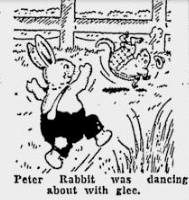
Johnny Chuck moved a bit nearer the fence. He reached forward with an inquisitive black nose and touched a wire that was in the way. Perhaps he thought it was just a vine or a root that he could cut. Instantly, Johnny Chuck turned a back somersault, fat as he was. He fell on his back sprawling, and he was so fat that he had hard work to roll onto his feet again. Peter Rabbit was dancing about with glee. This is what he hoped for. This was what had happened to him the night before.
Instead of playing up the humor (as he would have in 1912) Burgess came down hard against it.
This was his idea of a joke. A lot of people are like this. They think that unpleasant things they cause to happen to other folk are jokes, are something funny to laugh at. They are altogether wrong. 
The callous pranks of the earliest stories have, in fact, been a stumbling block for some modern parents trying to use Burgess books for moral instruction. By 1953 Burgess seemed to realize himself that such things were no longer appropriate. 

Sunday, December 9, 2012

Thornton Burgess reads The Joy of the Beautiful Pine

Here's something to get people into the holiday spirit. A recording of one of Thornton Burgess's most favorite stories, "The Joy of the Beautiful Pine," from a 1918 Columbia Grafanola record.


I labeled this a "trial" recording as I was still figuring out the best place to position the camera during the shoot. It doesn't help the sound quality that Burgess (yes, that's him reading, New England accent and all) has to compete with an orchestra playing Christmas carols half-way through.

Here's a bonus (also to be re-recorded): "Johnny Chuck Finds the Best Thing in the World."

I find it interesting that Burgess pitches another record (to be bought separately) at the end of the side.