Tuesday, December 11, 2012

Burgess Bedtime Stories 1953


The Stories


January 1 to January 8. (continued from 1952). Terror the Goshawk drives the grouse from the Old Orchard. Then he pushes his way into a bramble tangle to try to get Peter Rabbit.

January 9 to January 13. Yowler the Bobcat tangles with Whitey the Snowy Owl.

January 14 to January 27. Glutton the Wolverine returns to the beaver pond and tears apart Paddy's lodge. Later the beavers must work quickly and carefully to fix a leak in their dam.

January 28 to January 31. Farmer Brown's boy feeds the birds. They pay him back for the food. Even Croaker the Raven is a worker of sorts. 

February 2. Johnny Chuck thinks Groundhog Day is foolishness.

February 3 to February 6. Lightfoot can still fight without his antlers, Old Man Coyote learns to his regret.

February 7 to February 18. Reddy Fox contends with Little Joe Otter and Billy Mink for fish. Then Reddy and Mrs. Reddy work together to get hens. Reddy jumps on a passing sled to escape the angry farmer. 

February 19 to February 23. Jumper the Hare and Mrs. Grouse dodge Tufty the Lynx and Old Man Coyote.

February 24 to March 16. Blacky the Crow is unhappy when he discovers the great-horned owls are going to use his nest. Then he and other crow helps a young crow wounded by a hunter using an owl decoy [five other crows perished]. The wounded crow watches a competition between male grouses, broken up by Reddy Fox.

March 17 to April 11. Mrs. Grouse nests under a tree housing a Red-tailed hawk nest.  Mrs. Grouse doesn't think highly of the parenting style of the hawks. Later she tries her best to keep the chicks safe from predators. She is only partially successful. One young grouse gets separated and must fend for herself in a dangerous world.

April 13 to June 1. There are new bear cubs, Totty and Taddy. After some misadventures they are caught by a farmer and placed in a pen. Mother Bear rescues them. Later Taddy has a dangerous encounter with his father, and the bear cubs play with otters and encounter a moose.They learn to eat ants and respect yellow jackets.

June 2 to June 30. Mrs. Lightfoot must protect her children from bear cubs, coyotes, and foxes. Then Wee Spotty gets lost and is adopted temporarily by a boy who thinks she'd been orphaned. Later Mrs. Lightfoot fights off a dog and a rattlesnake, while Lightfoot is bothered by antler buds.

July 1 to July 23. Ragtail, Broadtail, and Brushtail the young gray squirrels must fend for themselves when Mrs. Happy Jack has a new family. Meanwhile Mrs. Happy Jack must move her babies when Mr. Blacksnake discovers her nest. Happy Jack helps draw predators away from her. 

July 24 to July 31. Shadow the Weasel is a good father to his baby weasels. Even his babies aren't afraid of foxes (though one should have been afraid of owls). 

August 1 to August 4. Peter Rabbit tries to understand a rain of worms. Farmer Brown's boy attributes it to a tornado.

August 5 to August 11. Mrs. Grouse tries to outwit Reddy Fox. When that doesn't work she slaps him in the face. 

August 12 to August 14. Sally Sly the Cowbird is back. Farmer Brown's boy intervenes. 

August 15 to August 19. Peter Rabbit watches a wasp bury a grasshopper. Then he learns about walking sticks. 

August 20 to August 29. Greedy Grandfather Frog gets a big fish stuck in his throat. Snapper the Turtle takes care of it. 

August 31 to September 11. Farmer Brown's boy tries a variety of methods to keep animals from his garden, including a young owl. Peter Rabbit and Johnny Chuck are shocked by a new electric fence around Farmer Brown's garden.

September 12 to September 14. Broadwing the Hawk,  a grasshopper eater, is unfairly persecuted by hunters. 

September 15 to September 23. Peter Rabbit says so-long to swallows and bobolinks. Then he meets a little blue heron and a snowy egret at the Smiling Pool until they too have to move along. 

September 24 to November 12. Jerry Muskrat leaves the Smiling Pool to find a new home and has an adventure. Eventually he ends up at a cornfield, where he is chased by a dog, has to fight a young fox, and run away from boys with sticks and stones. When he gets home he builds a home just in time for a flood. Later Young Jerry loses his foot in a trap but can still defend himself. 

November 13 to December 31. Mrs. Quack, who has already lost five children to predators, speaks out against the unfairness of hunters. Meanwhile Reddy Fox and his son Little Too-Smart try to get some young ducks for themselves. Later the young fox (wounded by a hunter) must learn how to trick pursuing dogs. Reddy teaches him the ride-on-a-sheep trick. Then Gray Fox shows the young fox how he climbs trees and frames him as a hen-stealer. The year ends with Too-Smart finding a potential mate. (continued in 1954).

Notes


Thornton Burgess continued the use of longer elaborate episodes in 1953, though these tended to comprise rather familiar scenarios. Nevertheless, for the first time Burgess focused attention on the family life of Shadow the Weasel. Even his greatest villain, it seems, was a good father, though his family's happiness, Burgess was clear to point out, came at the expense of others. Glutton the Wolverine, no longer an animal living in the faraway north, came back to seek revenge for his humiliation in the pond of Paddy the Beaver the previous year.  The one animal with the strength to rip apart the beaver lodge during the winter, Glutton's destructiveness was balanced by his effectiveness at foiling the plans of trappers. 

Burgess, many decades removed from the pranks and slapstick of his earliest stories, directly addressed the morality of such jokes in 1953. After Peter Rabbit was shocked (and did a backwards somersault) after touching an electrified fence, he set up his friend Johnny Chuck to have the same experience.
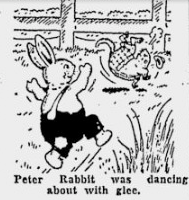
Johnny Chuck moved a bit nearer the fence. He reached forward with an inquisitive black nose and touched a wire that was in the way. Perhaps he thought it was just a vine or a root that he could cut. Instantly, Johnny Chuck turned a back somersault, fat as he was. He fell on his back sprawling, and he was so fat that he had hard work to roll onto his feet again. Peter Rabbit was dancing about with glee. This is what he hoped for. This was what had happened to him the night before.
Instead of playing up the humor (as he would have in 1912) Burgess came down hard against it.
This was his idea of a joke. A lot of people are like this. They think that unpleasant things they cause to happen to other folk are jokes, are something funny to laugh at. They are altogether wrong. 
The callous pranks of the earliest stories have, in fact, been a stumbling block for some modern parents trying to use Burgess books for moral instruction. By 1953 Burgess seemed to realize himself that such things were no longer appropriate. 

Sunday, December 9, 2012

Thornton Burgess reads The Joy of the Beautiful Pine

Here's something to get people into the holiday spirit. A recording of one of Thornton Burgess's most favorite stories, "The Joy of the Beautiful Pine," from a 1918 Columbia Grafanola record.


I labeled this a "trial" recording as I was still figuring out the best place to position the camera during the shoot. It doesn't help the sound quality that Burgess (yes, that's him reading, New England accent and all) has to compete with an orchestra playing Christmas carols half-way through.

Here's a bonus (also to be re-recorded): "Johnny Chuck Finds the Best Thing in the World."

I find it interesting that Burgess pitches another record (to be bought separately) at the end of the side.

Burgess Bedtime Stories 1952


The Stories


January 1 to January 7. (continued from 1951) Drummer the Woodpecker is trapped in a hole after an ice storm. Farmer Brown's boy (searching for trapped grouse) rescues him. 

January 8 to January 21. Lightfoot the Deer loses his antlers but is still able, with the assistance of Mrs. Lightfoot, to fight off marauding dogs.

January 22 to January 25. Spooky the Screech owl catches mice and commiserates with Blacky the Crow. 

January 28 to February 5. Many animals, desperate with hunger, are tempted by a baited trap but only a young mink goes for it, losing a leg in the process. 

February 6 to February 27. The flying squirrels move into a birdhouse in the Old Orchard. 

February 28 to April 22. Peter Rabbit discovers, to his chagrin, that the great-horned owls are already nesting. Hooty pursues him but ends up with a talon full of porcupine quills. When Prickly Porky comes to reside in their tree, the owls are initially disturbed but eventually come to appreciate the defense against nest raiders. Later Young Hooty learns that hunting is hard and Sister Hooty gets caught in a trap after discovering chickens. (Farmer Brown's boy bails her out). 

April 23 to May 14. Old Mr. Toad has familiar misadventures on the way to the Smiling Pool (falls in a hole, escapes from snakes). 

May 15 to June 7. Tiny Toad (soon "Little Toad") learns about the dangers of the Great World. Later Old Mr. Toad teaches him how to eat a worm properly. 

June 9 to July 5. Johnny Chuck's clever use of backdoors tricks Reddy and Mrs. Reddy Fox as well as Peter Rabbit. Later Johnny moves in with Peter Rabbit after his home is discovered by a rattlesnake. 

July 7 to August 23. Reddy and Gray Fox play tricks on each other. Later Reddy's son, "Little Mr. Too-Smart," (with the assistance of his parents) must learn to avoid porcupines, skunks and rattlesnakes. Later the young fox has misadventures at the Smiling Pool and berry patch.

August 25 to September 1. The Kingfishers must defend their hole against "Prowler" [a new name] the Blacksnake. Later a young kingfisher is killed by Snapper the Turtle.

September 2 to September 5. Peter Rabbit gets caught in a box and is tormented by Flip the Terrier. Farmer Brown's boy puts an end to it. 

September 6 to September 20. Paddy the Beaver has a life-or-death struggle with Glutton the Wolverine. Then Glutton steals a deer from Puma the Cougar, destroys a trapper's cabin, and disrespects Flathorns the Moose. 

September 22 to September 30. Farmer Brown's boy creates an elaborate test of Striped Chipmunk's intelligence.

October 1 to October 25. Wee Bunny becomes "Ragged Ear" after an unprovoked attack by Chatterer the Red Squirrel. The young rabbit must learn to see through Reddy Fox's deceptions. 

October 27 to November 1. Peter Rabbit discovers that the "young snakes" that he saw being taken into their "Mother's" mouth are actually tiny ring-necked snakes, not babies at all. They are being eaten, not protected.

November 3 to November 11. Peter Rabbit learns about bee swarms (the hard way). 

November 12 to December 10. Wee Mite the Meadow Mouse survives the onslaught of different predators (lncluding a shrew) to become "Mite." After a snow fall he moves into "Mouseville" and raises his own family. After 16 weeks he is already a grandfather. 

December 11 to December 20. After Jimmy Skunk moves into the old woodchuck hole in the Old Briar Patch, Peter and Mrs. Peter Rabbit don't know whether to trust him or not. 

December 22. Tommy Tit taps on Farmer Brown's boy's window to get him to remove the ice from the seeds on the feeder. 

December 23 to December 24. Buster Bear goes to bed under a tree out in the open but is shocked when the tree falls down. 

December 25. Christmas story[?]. Unread. I do not know the title. 

December 26 to December 31. Mrs. Grouse gets out of the snow cover before being trapped by an ice crust and feeds with Tommy Tit in the Old Orchard. 

Notes


Thornton Burgess was still going strong in 1952, offering up more elaborate, extended stories than he had in years. His stories included one of his most memorable fight scenes, in which Paddy the Beaver had to contend with the seemingly unstoppable Glutton the Wolverine, as well as an apparent answer to an old obsession--do mother snakes take their young into their mouths for the purpose of protection? [Probably not.] 

In what (to me) might be the most shocking scene in the entire 50 year body of Burgess stories, Chatterer the Red Squirrel tried to kill innocent little Wee Bunny, for no other reason than he was in a bad mood. 
Chatterer jerked his tail angrily. He scolded as only he can scold. He was working himself into a rage. It is a way some folks have of doing. Suddenly he jumped to the ground and ran straight at Wee Bunny. The little Rabbit wasn't prepared for this. He had never been in a fight in his short life. He really was quite helpless. Chatterer leaped on him and bit. He bit hard. It hurt dreadfully. Wee Bunny screamed. He couldn't help it. He struggled and tried to get away, and couldn't. Chatterer's teeth were sharp. They tore his coat. They tore one of his ears. He screamed again. He struggled in vain. He could neither fight, not could he get away. All at once the Great World had become a terrible place. And Chatterer the Red Squirrel had become a monster. 
Burgess's explicit purpose was to show how young animals can never let down their guard, but it is worth reflecting on the transformation of a formerly sympathetic character into a brutal monster. 

Finally, Burgess directly addressed dramatically a theme that he had been discussing for some time--the need for predators to check the population of meadow mice, tracing the short life of one of Danny and Nanny's sons as he matured into a father and then a grandfather in the span of 12 weeks. From the perspective of Wee Mite/Mite the world was a horribly dangerous place, with predators (weasels, cats, shrikes, foxes, kestrels, black snakes, even shrews) slaughtering relatives left and right. But given the reproductive prowess of meadow mice, Burgess made it clear why such predation was necessary. Meanwhile, "Grandfather Mite" simply did his best to survive and reproduce again. 


Friday, December 7, 2012

Burgess Bedtime Stories 1951


The Stories


January 1 to January 2. Reddy Fox's outlook on life brightens after he eats food left out by Farmer Brown's boy.

January 3 to January 20. Spite the Marten chases Chatterer the Red Squirrel but then must escape from Pekan the Fisher. 

January 22 to January 24. Glutton the Wolverine destroys a trapper's cabin.

January 25. Peter Rabbit wonders how Happy Jack can find buried nuts.

January 26. Mrs. Lightfoot and the twins find themselves trapped in their yard, with little food.

January 27 to February 3. Blacky the Crow envies folks able to fish during the winter.

February 5 to February 13. Flaptoes the [red-necked?] Grebe gets trapped on the ice. Farmer Brown's boy (alerted by Blacky the Crow) rescues him before Reddy Fox can get him.

February 14 to February 16. Peter Rabbit is surprised to find Welcome Robin during the winter.

February 17 to February 24. The great-horned owls begin nesting.

February 26 to April 21. Teeter the Spotted Sandpiper meets old friends (osprey, pelican) at his winter home on "Robin Crusoe's Island" (off the coast of Trinidad). Then Farmer Brown's boy arrives and learns about local animals including the "king of the woods" (motmot), Cousin Manicoe [manicou], Old Iggy the Iguana, Tatoo the Armadillo, and Big Claw the Land Crab. 

April 23 to May 4. The animals back home worry that Farmer Brown's boy's land is no longer a sanctuary. They rejoice when he returns. Reddy Fox shows him a trap set while he was away. 

May 5 to May 9. Redtail the Hawk kills a rat feeding on chicken eggs. 

May 10 to May 26. Chatterer the Red Squirrel unwisely tries to get red-tailed hawk eggs. 

May 28 to June 2. Peter Rabbit gets into deep water to escape detection by Gray Fox. Then Gray Fox, forced up a tree by a hound, is aided by Reddy Fox. 

June 4 to June 20. The two new bear cubs get chased by their father and rescued by their mother. Then they get into the sugar house and make a mess. Farmer Brown's boy and his friend have a comic encounter with the cubs. 

June 21 to July 6. Prickly Porky falls in the water after Paddy the Beaver cuts down the tree he was in. Then the porcupine drives off Buster Bear. 

July 7 to July 23. The animals compete over blueberries, but Jimmy Skunk wins. Farmer Brown's boy tries to get some too but, startled by Buster Bear, he drops his bucket and sits on a yellow jacket's nest. Jimmy Skunk eats all off his berries plus the yellow jackets. 

July 24 to August 3. Mrs. Peter Rabbit fights off Flip the Terrier and Mr. Blacksnake in defense of her babies.

August 4 to August 10. Shadow the Weasel goes after Striped Chipmunk even after Farmer Brown's boy tries to drive him off. Striped Chipmunk, it turns out, can take care of himself.

August 11 to September 5. Little Stripes the Chipmunk runs away and falls in with Little Two-Stripes the Skunk. They visit with Thunderer the Grouse. Then Little Stripes has adventures with Reddy Fox and Black Pussy and Little Two-Stripes is killed by a car.

September 6 to September 21. Peter Rabbit learns about hummingbirds. Farmer Brown's boy rescues Mrs. Hummer when she gets burrs caught on her wing. 

September 22 to October 6. Old Mr. Toad mentors a young toad on how to eat a worm correctly and escape from snakes. Farmer Brown's boy rescues the young toad from Jimmy Skunk by hooting like an owl.

October 8 to October 10. Farmer Brown's boy helps Aunt Sally celebrate her 90th birthday along with the woodchucks, "Little Gentleman" and "Fat Johnny." Alas, Goldie is missing. 

October 11 to October 17. Peter Rabbit comforts a tree swallow with a hurt wing who is afraid he's been left behind. 

October 18 to October 20. Johnny Chuck [AKA Fat Johnny] delays hibernation because he's getting fed so well at Aunt Sally's but the arrival of Reddy Fox at her door convinces him to retire for the winter. 

October 22 to November 2. Thunderer and Mrs. Grouse know a few tricks when it comes to hunters. Meanwhile Peter Rabbit comforts a young grouse until Farmer Brown's boy comes along, surveying his sanctuary for wounded animals.

November 3 to November 26. Mrs. Lightfoot frets about the condition of her yard and the twins learn to fear humans. Then they watch as Buster Bear contests with Bobby Coon and Flathorns the Moose. 

November 27 to December 1. Old Man Coyote is sure he is going to get young beaver this time. He is almost crushed by a falling tree instead.

December 3 to December 15. A very sleepy Nimbleheels the Jumping Mouse must find a safe place to stay over the winter.

December 17 to December 22. Peter Rabbit (once again) tries to predict the severity of the coming winter by reading the bands on Wooly Bear. Then Sammy Jay tries to eat the caterpillar but finds him too hairy.

December 24 to December 25. Buster Bear decides to retire for the winter. 

December 26 to December 31. Drummer the Woodpecker gets trapped in a hole after an ice storm. (Continued in 1952). 

Notes

Farmer Brown's boy was back at the center of things in 1951, going on an extended trip to Trinidad where he learned about local animals. (Trinidad was Thornton Burgess's winter home.) The New England animals noticed his absence, fearing that his land was no longer a safety zone, and were very glad to see him when he returned (Burgess had Reddy Fox bark a "hello.") Later Farmer Brown's boy's role as the animal's' guardian was reinforced as he made the rounds during hunting season looking for wounded animals.

1951 also featured one of Burgess's more shocking scenes, involving the sudden death of a named character, Little Two-Stripes the Skunk, the bold companion of Little Stripes the (scared) Chipmunk.
They met a small dog. Little Stripes ran for the nearest hiding place. The small Skunk didn't run at all. He stamped his feet at the small dog and threatened to make him sorry if the dog dared touch him...Two Stripes started along just as if nothing had happened. The Little Chipmunk hurried to catch up with him.  "I wish," said he, "that I had a little scent gun and was not afraid." 
That was a foolish wish. A few minutes later they came to a road. Far down the road was a strange and terrible thing rushing toward them. The little Chipmunk ran back out of the road as fast as his small legs could take him He was scared almost out of his wits. The little Skunk simply turned and faced the monster coming so fast. He wasn't afraid. He stamped his feet. The terrible monster rushed on. It was an automobile. Not being afraid cost the little Skunk his life. The little Chipmunk who had wished that he was not afraid was still alive because he was afraid.
While the scene reinforced an old Burgess theme--the danger of ignorant boldness--it does seem to violate an implicit Burgess rule about not killing off characters with names (that is, characters not named "little too smart" or the like). 1951 also marked the end of "Little Golden Coat," whose demise was not depicted on stage but whose "disappearance" was mentioned by Aunt Sally. While Johnny Chuck was an apparent immortal, "real-life" animals had more realistic life expectancies.


Wednesday, December 5, 2012

Burgess Bedtime Stories 1950


The Stories


January 2 to January 7. (continued from 1949) Blacky the (domesticated) Rabbit escapes but quickly has too much adventure and wants to return to "prison." Peter Rabbit is disgusted by his helpless companion, spoiled by too much welfare. 

January 9 to January 11. Jumper the Hare, now in his white coat, hides from Reddy Fox.

January 12 to January 24. Lightfoot the Deer loses his antlers and Mrs. Lightfoot makes a yard for her and the twins. Meanwhile Jumper the Hare is peeved that the deer have spoiled a large section of forest.

January 25 to January 27. Reddy Fox, desperate with hunger, is tormented by crowing roosters and meadow mice hiding in the snow.

January 28 to February 4. The grouse plunge into the snow to avoid Terror the Goshawk. They leave the snow just in time to avoid an ice storm. 

February 6 to February 8. Farmer Brown's boy leaves out a hen for Reddy Fox. Reddy lets Mrs. Reddy have most of it. 

February 9 to March 1. Nibblet the young house mouse learns to avoid traps and rats. He lives in the barn (a "mouse paradise") until Spooky the Screech Owl starts terrorizing the place. Then he travels with Whitefoot the Wood Mouse until he sees a fox catching meadow mice and he wants to return home. 

March 2. Tommy Tit makes people happy during the winter. Peter Rabbit is envious.

March 3 to March 6. Peter unlearns the belief that all frogs hibernate when he meets Croaker the Green Frog. 

March 7. Peter Rabbit discovers that the tips of twigs are beginning to taste sweet--a sign of spring.

March 8. Despite the cold weather, Hooty and Mrs. Hooty are already nesting.

March 9 to March 18. Reddy and Gray Fox vex each other. 

March 20 to April 8. Peter Rabbit uses Johnny Chuck's hole to escape from predators (Johnny is peeved). Then Johnny must fight a rival for Polly. They make a new home in the Green Forest. 

April 10 to April 15. Everyone is celebrating the arrival of spring, especially Peeper the Hyla and Old Mr. Toad. 

April 17 to April 20. Stalkeye the Snail tells Peter Rabbit about his troubles.

April 21 to May 8. Peter Rabbit learns first-hand about shrews (who have invaded the briar patch), including the amazing Waterfoot the Water Shrew.

May 9 to May 11. Reddy Fox (unfairly) criticizes Johnny Chuck and Jimmy Skunk for being poor fathers. The truth is that woodchuck and skunk mothers don't need food brought to them. 

May 12 to May 20. Allie, an albino bluebird, befriends a fellow outcast, a black squirrel. 

May 22 to May 27. Mrs. Toad has misadventures on the way to the Smiling Pool.

May 29 to June 27. Rattles and Mrs. Rattles have a new family of kingfishers. Billy Mink tries, unsuccessfully, to get some. Later a young kingfisher gets a mussel caught on his bill. 

June 29 to July 12. Sally Sly's attempts to place her eggs are foiled by Jenny Wren (pierces egg) and Sunshine the Yellow Warbler (builds nest over cowbird egg) but she is able to find the "welfare" she is looking for from Little Friend the Song Sparrow. Black Pussy eventually chases the cowbird chick away.

July 13 to July 24. Little Jim the Skunk gets lost but learns he can defend himself. Eventually he ends up in the henyard and Farmer Brown's boy adopts him as a pet. Little Jim earns his keep by eating grasshoppers. 

July 25 to July 31. Peter Rabbit thinks that Logcock the Pileated Woodpecker is ruining trees but Unc' Billy Possum sets him straight. 

August 1 to August 23. Little Billy the Possum learns to keep himself safe

August 23 to September 2. Peter Rabbit and Jumper the Hare debate whether Unc' Billy Possum is in control of playing dead. Then Buster Bear tears down a tree to try to get him. Buster has a painful encounter with Prickly Porky instead. 

September 4 to September 12. Prickly Porky gnaws on an antler and Little Prickly teaches a young fox to get out of the way of porcupines. [Burgess makes some political remarks about the national defense]. 

September 13 to September 16. Reddy Fox and Bobby Coon compete for wild grapes. Bobby eats too many grapes.

September 18 to September 23. The folks at the Smiling Pool start getting ready for winter.

September 25 to September 29. Billy Mink takes a fish dropped by an osprey but soon finds it missing. Bobby Coon took it.

September 30 to October 19. Bobby Coon gets shot by a hunter but remembers the kindness of Aunt Sally. Meanwhile Aunt Sally invites a hunter to have breakfast with her and Goldie (AKA "Little Golden Coat") the Woodchuck. Goldie's love of apple pie causes the hunter to have a change of heart. 

October 20 to October 23. Chatterer must make the best of things after a storm destroys his storehouse.

October 24 to November 11. Honker's family begins their great flight south. On their way they watch as Flathorns convinces a rival for Mrs. Flathorn's affection to give up. Then they avoid minks and raccoons and Honker does his best to keep them away from hunting grounds. 

November 13 to December 2. The geese learn about Finback the Whale and "Bigmouth" the Baleen Whale, on their way across the ocean. Then Pilot the Whale must lead his school through a treacherous pass in order to escape from "The Terrible One" (killer whale). 

December 4 to December 23. Reddy Fox takes advantage a rabbit-hunting beagle to catch some rabbits for himself. Later he is shot by a hunter but it is was worth it

December 25. "Christmas in the Old Pasture" (Unread).

December 26 to December 30. Farmer Brown's boy reads the story of a three-legged fox in the snow. He leaves out a dead hen for the fox and its mate.

Notes

1950 was a tragic year for Thornton Burgess personally, his wife, Fannie, dying in August. Despite (or perhaps because of) this, Burgess's creative power seems to have been reinvigorated, offering up new scenarios (Pilot the Whale vs. the Killer Whale) and some of his most well-crafted chase scenes (Peter Rabbit vs. both a beagle and a fox). The U.S. was at war again, prompting new references to national defense (through the character of Prickly Porky), and Burgess continued his now familiar critique of "welfare," particularly among domesticated animals. Appearances of Farmer Brown's boy were scarce, continuing a trend started the previous year. 

 "Little Golden Coat" made a reappearance, this time at Aunt Sally's for breakfast (an "old New England" breakfast featuring apple pie). In the story Aunt Sally uses the breakfast as an opportunity to convince a local hunter to stop killing woodchucks for sport. Burgess directly confronted some claims made by sportsmen (and himself, long ago):
Her guest of honor was a hunter who thought of himself as a sportsman and was most indignant when Aunt Sally wondered how he could so love to kill. "I don't love to kill," he protested. "It is the hunt, not the kill, that I love; the being afield and trying to be smarter than those I hunt. It is a sort of game, an exciting game." 
"But you don't feel that you have won unless in the end you kill the one you are hunting, and you are disappointed if you don't. If you didn't like to kill as well as hunt you wouldn't shoot Woodchucks. You don't eat them. You don't use their fur. Dead they are of no earthly use to you. But you try to kill them just the same. Why?" said Aunt Sally. 
The hunter claims the woodchucks are a common agricultural nuisance, which Aunt Sally refutes by reference to the woodchucks now eating apple pie on her kitchen floor. Eventually the hunter, charmed by the sight, concedes and pledges to leave the woodchuck shooting to farmers who are being directly harmed by particular woodchuck pests. 

Monday, December 3, 2012

Burgess Bedtime Stories 1949

The Stories


January 1. Peter Rabbit is chagrined to realize he has written his own story in the snow. 

January 3. Flip the Terrier falls through the ice chasing Reddy Fox.

January 4 to January 8. Jumper the Hare dodges predators in the snow.

January 10 to January 11. Gray squirrels talk to each other using their tails.

January 12 to January 17. Reddy Fox and Roughleg the Hawk fight over Danny Meadow Mouse. 

January 18. Tommy Tit rejects bad seeds at the feeder.

January 19 to January 29. Reddy Fox assists a young fox caught in a steel trap. Farmer Brown's boy, reading the story in the snow, comes to the rescue. Later Reddy teaches the young fox how to spring traps. 

January 31 to February 7. A three-legged muskrat meets a three-legged raccoon. Their legs were lost due to steel traps. 

February 8 to February 19. Farmer Brown's boy is only able to save two of the three grouse caught under the ice crust. He leaves the third for Reddy Fox.

February 21 to February 26. Farmer Brown's boy leaves out food for the foxes after he sees Reddy eating frozen apples in the Old Orchard. The foxes, fearing traps, are initially suspicious of the food. 

February 28 to March 7. Peter Rabbit discovers the mystery singer is Whitefoot the Wood Mouse.

March 8 to March 17. Peter Rabbit discovers Prickly Porky's hidden vulnerability. 

March 18 to April 4. Farmer Brown's boy has fun with Trader the Wood Rat. Later Trader drums with his tail. [In this story, Farmer Brown's boy meets with Trader for the first time]

April 5 to April 18. Peter Rabbit compares the tails of many different animals.

April 19 to April 21. Farmer Brown's boy hand delivers feathers to the tree swallows.

April 22 to May 2. Jenny Wren is unfairly accused of breaking a robin egg. Then the birds accuse male mammals of being bad fathers. 

May 3 to May 19. Farmer Brown's boy inadvertently causes panic in the flying squirrel home. He makes the mother flying squirrel take one baby from his hand as a test of her courage. Later he adopts the little flying squirrel, Runty, after rescuing it from Black Pussy. 

May 20 to June 9. Peter Rabbit feels sorry for the chipmunks when Mr. Blacksnake goes after their babies until he learns that chipmunks raid birds' nests. Later a young chipmunk (Little Stripes) visits the Smiling Pool and finds friends (Leaper the Leopard Frog) and dangers (dog and heron) there. 

June 10 to June 16. Old Man Coyote, a "displaced person" (Burgess compares him to a post WWII refugee), is homesick. He tells Peter Rabbit about Grubby the Pocket Gopher. Meanwhile, Peter alerts Miner the Mole that he is being stalked by the coyote. 

June 17 to July 19. Old Man Coyote's reminiscences lead to a set of stories about the animals of the American West, including badgers, kit fox, kangaroo rat and  prairie dogs. 

July 20 to August 15. Swifty the young coyote and Thunderbolt the Golden Eagle try to get young pronghorn antelopes.

August 16 to August 26. Little Kid Surefoot the Mountain Goat avoids Old Grizzly and is amazed by the springy legs of Bighorn the Mountain Sheep. Later he gets acquainted with Little Chief Hare the Pika.

September 5 to September 20. Bugler the Elk locks antlers with a rival. A forest ranger arrives before predators can get them. Burgess ends with a story about "The Old One," an ancient elk who is nearing the end of his "usefulness." 

September 21 to September 24. Peter Rabbit cools down in the Smiling Pool.

September 26 to September 29. Paddy the Beaver plans ahead for winter.

September 30 to October 1. Lightning starts a forest fire, frightening Buster Bear. But then the ensuing rain storm ends the red terror. (Reprinted in At Paddy the Beaver's Pond).

October 3 to October 17. Buster Bear thinks he owns the forest but is proven wrong by skunks, porcupines, and Flathorns the Moose.

October 18 to October 19. Flathorns the Moose confronts a rival. 

October 20 to October 24. Paddy the Beaver and Buster Bear disagree about how to approach the winter.

October 25 to October 29. Squirrels and blue jay compete for nuts. 

October 31 to November 7. Nimbleheels the Jumping Mouse goes to sleep just in time.

November 8 to November 18. Striped Chipmunk eats snails and blacksnake eggs.

November 19 to November 28. Bob White teaches Peter Rabbit about his wings. Then, reunited with his family for Thanksgiving, Bob White invites a new member to his flock whose family had been killed by hunters. 

November 29 to December 6. Peter Rabbit thinks there are signs indicating whether the coming winter will be hard or not. Wooly Bear disagrees. 

December 7 to December 27. Whitefoot the Wood Mouse and Danny Meadow Mouse move into a cornstalk castle but their happiness is short-lived when Farmer Brown's boy pulls apart the corn shock. Nanny must rush to move her babies.

December 28 to December 31. Peter Rabbit feels sorry for Farmer Brown's boy's domesticated rabbits. (continued in 1950).

Notes.


In 1949 Burgess revisited the American West. This time the stories were initiated not by Farmer Brown's boy going on a trip (as in 1931) but by Old Man Coyote's homesickness. While not a strict rerun of the 1931 stories, the new stories did repeat many of the characters and scenarios from 18 years earlier. One of the most striking episodes (September 20) featured an old elk, once the "Great One" now the "Old One," contemplating a dire future.

He was alone, the "Old One." That is what he was called and that is what he was, the oldest of all the Elk on the High Mountains. He was alone because he could no longer command the respects of others, and he could no longer command their respect because he was old. So they treated him with scorn, or paid no attention to him whatever, even his own children. Young Elk, filled with pride in their first antlers, which as yet were no more than spikes, treated him with the utmost disrespect and scorn. They were the ones who first called him the "Old One." Now everyone did. They made it clear that he was useless and they didn't want him around. 
I don't think this necessarily reflects any bitterness on Burgess's part about his own advancing age. Rather he is matter-of-fact about the reality of old age in the natural world.
He was useless to any one now [in the summer], but then he would once more be of use for a little while, perhaps in the bitter season of mid-Winter starvation, saving the life of some one, or perhaps the lives of several. It is Mother Nature's way. There is no continued place for the useless. 
The only ones who want him now are predators.

It is also worth noting a subtle shift in Burgess's attitudes toward the species of some of his own most popular characters. Rabbits joined meadow mice as animals prone to overpopulation. (He even had Peter Rabbit  agree that maybe there could be "too many rabbits.") Meadow mice could be "useful" but as food for foxes and hawks (not unlike saying mosquitos are "useful" as food for bats). Meanwhile, Striped Chipmunk, ultimately was no better than Mr. Blacksnake, in his taste for bird eggs and chicks. 

Saturday, December 1, 2012

Burgess Bedtime Stories 1948


The Stories

January 1 to January 12. Snowflake the Snow Bunting tells a story about Snow-King the Polar Bear and Spitzy the Arctic Fox.

January 13 to January 26. After Mrs. Reddy is wounded in a henhouse raid, Reddy must find food for both of them. Farmer Brown's boy helps out.

January 27 to February 2. Butcher the Shrike terrorizes the Old Orchard but gains respect when he chases away pesky starlings.

February 3 to February 9. Which young meadow mouse will be killed by Butcher, "Little Mr. Caution" or "Mr. Know-it-all?" 

February 10 to February 17. Sammy Jay uses his hawk call for mischief and good.

February 18 to February 21. Blacky the Crow despairs when he gets tangled in a piece of string. Farmer Brown's boy finds him before Reddy Fox gets him.

February 23 to February 25. Peter Rabbit learns about two three-toed woodpeckers, Cousin Ladderback and Cousin Three-toes [they are apparent accidental vagrants to Massachusetts].

February 26 to March 5. Timmy the Flying Squirrel and Spooky the Screech Owl move into the Old Orchard. Tommy Tit is not unhappy.

March 6 to March 12. The sap is running and Farmer Brown's boy pays tribute to an old maple that's served his family for generations. He reads the story of a bear and a pail from tracks in the snow.

March 13 to March 16. Whiskey Jack the Canada Jay accepts a dare from Sammy Jay.

March 17 to March 18. Prickly Porky chews on an axe handle.

March 19 to March 23. Peter Rabbit encounters two drummers--grouse and woodpecker. 

March 24 to March 25. Peter Rabbit is surprised to find Cousin Flitwing and Mourning Cloak in an old stump.

March 26 to April 6. Mouser the Short-eared owl and Harrier the Marsh Hawk help Farmer Brown.

April 7 to April 9. Mrs. Peter Rabbit moves her babies after seeing Jimmy Skunk in the Green Meadow. 

April 10 to April 13. Farmer Brown's boy argues with his neighbor about the nature of "vermin." 

April 14 to April 17. Longlegs the Heron hunts meadow mice in the field.

April 19 to May 3. Peter learns about a variety of marsh birds, including coots, common gallinules, sora and rails. 

May 4 to May 13. Blacky the Crow schemes to get coot babies but gets tricked in the end.

May 14 to June 2. Mrs. Lightfoot must protect her twins from outlaw dogs, Buster Bear, and foxes.  Lightfoot and Farmer Brown's boy help out.

June 3 to June 11. Cresty the Great Crested Flycatcher gets his snake skin.

June 12 to June 15. Peter Rabbit is stunned when Wooly Bear turns into Isabella Tiger Moth.

June 16 to June 21. Jimmy Skunk does a handstand. (Thornton Burgess had a pet that did this.) Then he flees from Hooty.

June 22 to June 29. Bobby Coon shows Reddy Fox how to fish in the mud for frogs.

June 30 to July 10. Sally Sly the Cowbird is back, this time victimizing Little Friend the Song Sparrow.

July 12 to July 31. Old Mr. Toad eats his old suit and tries to mentor younger toads. Jimmy Skunk is about to eat him when Flip interrupts. 

 August 2 to August 5. Bubbling Bob the Bobolink cheerfully sings. Black Pussy can't find the nest.

August 6 to August 28. Reddy Junior learns which animals to avoid. Then his father teaches him how to evade a chasing dog. Later he is shot, but not badly wounded, when he raids a henhouse. And he is surprised to learn woodchucks can climb trees.

August 30 to September 7. Peter Rabbit learns about dobson flies.

September 8 to September 11. Peter Rabbit is shocked when a garter snake ties itself into a knot and avoids being swallowed by a king snake. [A "true" story]

September 13 to September 14. Blacky the Crow catches Reddy Fox napping.

September 15 to September 18. Flying squirrels and hares frolic in the moonlight, until Hooty comes and breaks up the party. 

September 20 to September 21. A boastful young mink needs to learn that sometimes it is good to be afraid.

September 22 to October 2. A forest fire (caused by a carelessly discarded cigarette) brings animals that are normally enemies together. 

October 4 to October 28. Paddy and Mrs. Paddy the Beaver leave their home and return to the Green Forest because of the fire. They build a new dam and a new home in the bank, while dodging Tufty the Lynx and dealing with pesky bear cubs who make holes in the dam. 

October 29 to October 30. It is hunting season again and all the animals are frightened, especially a wounded young bob white. 

November 1 to November 8. Happy Jack and Chatterer disagree how to store nuts over the winter. After Buster Bear finds Chatterer's storehouse, Happy Jack is convinced it is better to scatter nuts. 

November 9 to November 13. Blacky the Crow is too smart to be taken in by a decoy owl but a doomed young companion falls for it. 

November 15 to November 25. The Quacks do their best to survive during hunting season. Then they find a perfect place to winter--the city park. 

November 26 to December 6. Blacky the Crow determines that winter is harder on predators than prey. 

December 7 to December 24. Timid Miss Mouse survives in the great world (unlike her siblings, careless and bold), effectively hiding from Terror the Goshawk, and eventually finding a mate. 

December 25. "Something in the air" [Unread Christmas story]

December 27 to December 31. Bobby Coon gets caught in a steel trap but luckily Farmer Brown's boy comes to the rescue. Even though he "doesn't know Farmer Brown's boy" he allows the boy to approach and pull the jaws of the trap apart. [A "true" story]


Notes 

There a few things to note about 1948, in other respects a rather "familiar" year for Burgess stories. In April and May Burgess wrote about a group of related birds--this time aquatic marsh dwellers such as sora and rails. This repeated a pattern shown the previous year in which Burgess explored the differences and similarities of swallow species. 

More "true life" tales were turned into 1948 stories, including an account of a garter snake that knotted itself and thus avoided being swallowed by a king snake. (This seems to be "nature fakery" on the face of it, but Burgess avoided claiming the knot was intentional and garter snakes are known to tie themselves in knots so the story is believable). In another "true story" Farmer Brown's boy rescued a raccoon from a steel trap without getting bitten. Burgess named the raccoon, "Bobby Coon," but in a blow to series continuity, Bobby "didn't know" Farmer Brown's boy (who had saved him many times previously). This was a case in which Burgess once again displayed the convention that all animals of a species could be called the same name; at the same time, it ran against the nearly 28-year history of the character named "Bobby Coon." The two different modes of "truth"--"True life" and the fictional but fact-driven world of the Green Forest--could be at odds sometimes.

Finally it is worth noting at length Burgess's beautiful tribute to an old sugar maple (March 11):
There was one tree, biggest of all the Maple trees, that stood off at some little distance from the other maple trees. It was so big that it was a three-pail tree. That is, the big trunk was tapped at three places and a pail was hung at each. Of course, it takes many years for a tree to grow as big as was that maple. Once it had been just a one-pail tree, then a two-pail tree, and for longer than Farmer Brown's boy could remember it had been a three-pail tree. It was his favorite tree. 
"It must be the sweetest tree in all the world," he had once said, thinking of all the syrup and sugar that had been made from its sap down through the years.
"Perhaps not the sweetest in all the world, but it certainly is the sweetest in this particular part of the world. It was being tapped every spring when your grandfather was a little boy. I guess that if all the sap that has been taken from that tree could be  put in a pool there would be enough for you to take quite a swim in it," said Farmer Brown."...Some trees have given, and are giving, more to make the lives of others better and more worth living than have some folks I know. And they ask nothing in return, or very little. They give all their lives long, shade in summer, some of them fruit in season, beauty at all times, homes for the feathered folks and some furry ones. And when they are cut down they still give wood for building, heat and countless other uses. No axe will ever touch that big maple while I am alive." 
"Nor while I live," said Farmer Brown's boy. His father smiled, knowing that he meant it.
Thornton Burgess loved trees, even empathized with them, and deplored casual unthinking violence against them.